Showing posts with label 5 Meaning & Leadership. Show all posts

You are the carpenter of your own life...

You are the carpenter of your own life.
Get free, instant access to detailed reflection & planning resources. Then, start building!
Go to https://www.360living.co, scroll down to 360 LIVING TOOLKIT...

"This guide is a refreshing and empowering reminder that we can create our own happiness. It gives exactly the right guidance to do just that." Lianne, Canada

#inspiration #coaching #happiness #mindset #mindfulness #coach #planning #planning #nevergiveup #positivity #wellbeing #determination #determination #journey #award #balance #quote #go #now #achieve #living #congratulations #reflection #behappy #persistence #empower


Looking to improve your well-being? Start on a solid foundation...

When it comes to building a balanced, authentically happy life, a solid foundation can be our best friend. Sure, we can go about randomly implementing tips and strategies that we hear about online, from friends, etc. But is this approach really efficient?

We think you know the answer.

Trying to build happiness without a solid foundation is like trying to put together a puzzle with all the pieces upside down.
Sure, you could put it together if you spent enough time. Who are we to judge -- maybe you just like a challenge? Like...a nearly impossible challenge.
But if you're actually interested in making progress, why not just flip the pieces over first? You know, get a better picture of how they fit together.
Likewise, when your approach to happiness is based on random tidbits thrown at us in daily life, you might make a few centimeters of progress, but it's unlikely to lead to significant change. Especially when we're so bombarded with messages from every direction. It's difficult to know who to trust, and even once we have figured out who to trust, it can be difficult to actually find the time and motivation to put the pieces into place
What will help you make significant progress, though, is to take the time to understand all the particularities of your own life, and how they contribute to your happiness. By assessing our happiness in various areas of life, we get a clear picture of what needs to change. Even if you don't know how to change those things, that first step of evaluation is an incredibly valuable launchpad for remarkable change.
That's why we created a tool for assessment with the Authentic Happiness Survey, and it's also why we expanded that free survey and guidance even further in 360 Living. These two tools give people questions to start that important process of self-reflection. From there, you'll receive guidance to start improving the areas of life which most need it.
It's like knocking over that first little domino in a long line. Each little step you take gives you a bit of momentum to keep tackling more and more positive change in your life.

If you'd started in the middle, with a big domino, you might find it difficult or impossible to actually knock the first one over.

So when it comes to finding authentic happiness, the small and simple step of evaluation is so powerful: it creates a sense of accomplishment from very early on. By the time you've take the survey, you know already that you're doing something good for yourself (and for others around you, because we each touch many other lives just by taking care of our own happiness). That feeling of accomplishment and momentum helps to drive you toward more and more progress.
So we hope you'll go ahead and take those early steps. If you're short on time, take 10 minutes (20, if you're really thorough) to fill out the Authentic Happiness Survey, and afterward you'll receive customized email reports to help you start taking action for happier, healthier living. If you want to dive deeper into that process of evaluation and strategy-building, we invite you to check out 360 Living. This full-length book will prompt you to think critically about every area of your life, and start exploring why and how to improve each of them.

At the end of the day, your happiness is in your own hands.

The structure is all here to start building something great, today. Go put it to use and seize the day!


The Story of The Authentic Happiness Project

The story starts in 2013 with a question from Clara N.: where can I find one source of evidence-based research and simple, ads-free guidance to lead a better life?

landing20page202720aug20201620v5

The Authentic Happiness Project was first published as a global platform dedicated to collecting evidence-based research, providing quality educational content and analyzing new survey data in and around the subject of personal well-being.

  • www.Authentic-Happiness.com
  • All resources are free, no string attached, no registration required.
  • It includes a questionnaire to self-evaluate your well-being score, with instant feedback and other statistical reports to benchmark your response against 10,000+ other respondents globally.
360Living Website.jpg

In 2018, The Authentic Happiness project team partnered with www.360Living.co to publish some of its finding in a guide titled "360 Living"

360 Living embarks you on a journey of reflection, learning, and planning your best life:

"I've just finished reading 360 Living and although I'm not usually a reader of so called self help books, this practical and insightful book is hopefully destined to be a great hit with many people because it’s really fantastic." Mike Cahn

"Fantastic!! This book has changed my outlook completely. Through it I realized that work was exhausting all of my energy because I wasn't doing anything that I enjoyed anymore."
Brandon

"I absolutely loved this book. I rarely pick up books like this but it came recommended through a friend and I found it to be an addictive and satisfying read."L. D. Smith

360 Living guide


That's it! More to come...


What is your why, your inspiration and motivation? Not sure? Read further...


Sinek’s speech in his book “Start with Why" describes how understanding our “Why” creates more effective motivation and commitment. Our deeper motivations (our why) are a fountain of inspiration and energy, much more powerful than our daily actions (our what) or our intentional efforts (our how).

Take a moment and define that source of inspiration and energy for your own journey of better living. Go to 360living.co under toolkit for a free assessment.

The next step is in your hands.


New data from 360 Living reveal how much we miss out on our real lives. And what we should do instead.

One day, we realize that we missed out the real things in our life.

We miss out on critical time with loved ones that can never be replaced. We lose time for our hobbies.
We get so caught up in work that even off the clock, we find it hard to “switch off.” 
All this adds up to a major drain on our overall well-being:
  • British medical journal The Lancet published that working more than 55 hours puts a person at a higher risk of stroke, depression, and anxiety.
    (McGregor, J. Working more than 55 hours a week is bad for you–in many ways. The Washington Post, Aug. 2015)
  • 76% of workers feel tired many days of the week, and 15% of them even fall asleep during the day at least once per week
    (Chan, A. Most Workers Feel Tired At Work, Survey Shows. Huffington Post, April 2014)
  • Sleep deprivation (even a 1.7 hour gap) causes the U.S. economy to lose an estimated $63 billion in productivity every year
    (Dusik, 2011)
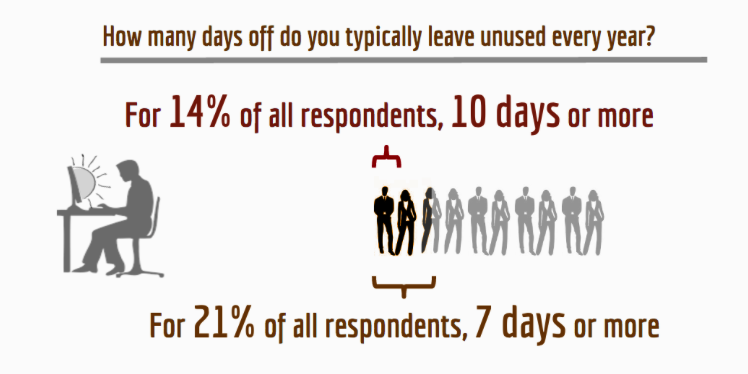
  • Nearly a quarter of respondents reported leaving seven or more vacation days unused (360living.co, 2017).

So, what should we do about this?

The dimensions of our lives are connected to each other.
Understanding and working with these connections is critical to create a solid and lasting foundation for living a good life.
Life is all about balance, and it’s only by taking a wide-angle approach that we can achieve that balance.

In the following are six concrete starting points to re-balance your life and optimize your work:

  1. Hone your skills and reach your greatest personal potential while maintaining a good life-work balance
  2. Discover what you love, develop your skills, tie them to your professional activities, and consider the many possibilities for achievement
  3. Use your skills and passions to create something of value and to make positive change
  4. Complete your Milestone Map to set smart goals for new personal achievements and build habits to accomplish them
  5. Track your time and activities in the Weekly Navigator: identify your main distractors and dedicate time to the things that matter
  6. Continue optimizing your activities and schedule; regularly assess your time and progress and reorganize elements that don’t work for you

The graphs, facts and recommendations in this article are extracted from 360Living, practical guidance for a balanced life.

If you like to get additional insights, free templates and tools to help you defined your structured approach to a balanced life, check the 360 Living Guide.

The next step is in your hands.


Where do we start making change? One week at a time.

A few years back, my co-founder and I started noticing  lots of people feeling unsatisfied. The problem: we don't know where to start making change.

We realized he could help solve this problem with data. To get people started on the right track, all it would take is a simple tool for assessment and action.
And so the Authentic Happiness Survey was born. The survey recommends a custom set of resources based on each participant's answers -- books, online assessments, and more.

Determined to inspire and empower even more people, in 2017 it was time to level up: sharing the findings as a full-length guide.

Years later, thousands of people had taken the survey and many had shared stories of how it helped them changed their lives. It was time to share the groundbreaking findings and recommend even more valuable resources.
That's when we partnered with Jacquelyn.

Jacquelyn was on her own journey of finding true happiness at the time, and this book was a way to put that experience to use and help others and to be part of something meaningful.

Jacquelyn travelling in Switzerland
Co-founding and co-writing 360 Living was more than "work." 360 Living is a project of passion for better living, and more importantly, it's something that we believe can truly make a positive impact for individuals like you, and for the world.

That's why we keep showing up in your inbox. We want you to TAKE THIS LITTLE LEAP TODAY for the better, because little leaps can make enormous impact.

Here's the thing..
We can only provide the tools. YOU are the carpenter of your own life. We hope you'll pick up those tools and put them to use, because you are capable of creating wonderful things with them.
Once again, here's the link to the sneak peek so you can do just that.
SEE WHAT'S INSIDE THE GUIDE
P.S. ready to take the leap toward better living right now? Get the full guide here!

How to re-balance our lives? One step at a time.


360 Living on Amazon:
After years of offering the free Authentic Happiness survey, we've taken it to another level to help people re-balance their lives: 200+ pages of key insights, personal assessments, & proven strategies & tools:
       CHANGE YOUR LIFE TODAY   
        Get your copy of 360 Living       
Readers are now discovering the path to true balance -- you can start doing the same. Today.
For the price of a few cups of coffee.
Just a few of the awesome 360 Living reviews:
It's up to you. Will you settle for just "getting by", or are you ready to thrive?
The next step is in your hands. Take action now. Get your copy of 360 Living today.

Get your story published, receive a free copy of the 360 Living Guide


We’re creating a guide to help people live better lives, and we’re accepting submissions of short personal stories, relevant experiences, and life lessons to accompany the groundbreaking statistics that will be shared in this book, tentatively titled 360 Living.

As a gift of appreciation, we will also offer you an electronic copy of the book and life improvement exercises when released on Amazon.

Format
Write your story in any format, from a couple of paragraphs up to 2 pages describing the context, your story and how it impacted your life or the lives of others. Include your preferred form of recognition to be published in the acknowledgement section and next to your submission, if selected. We can publish full name, first name or an alias (your email will remain confidential in any case). Please note submissions may be modified for inclusion in the book, but you’ll have the ability to review all changes.

How to participate
Pick any of the 14 themes or prompts below (or choose another theme about living a good and happy life, and we’ll see if it can be included), then email your short personal story to explorelearngrow@gmail.com.We can publish with your full name, first name or an alias (your email will remain confidential in any cases).

Selection criteria
Submissions will be selected based on relevance, ability to draw in and engage the readers, and portrayal of valuable and/or actionable lessons. Your story doesn’t have to be jaw-dropping, it just needs to have a clear lesson and a connection to living a better life. Simplicity can be stunning when done right.
Everyone has important stories to tell, and I’m excited to hear yours and share it in this book!

14 themes to choose from...

1. Resolutions and commitment
Keeping or not keeping our annual or general resolutions, tips and tricks, lessons learned.

2. Nutrition Story about nutrition and weight loss
What worked, what did not, key take-aways, sharing life lessons.

3. Appreciation & gratitude
Personal experiences about how expressing gratitude changed our relationships and resulted in a better life.

4. Physical fitness
A personal transformation, story about goals, what works for you, favorite activities, how you incorporate fitness into life, general feelings about fitness, impact of fitness and activity on other areas of life (lack of sleep, stress level, energy level, physical appearance).

5. Lifelong learning and mastery
A story about developing new expertise, lifelong learning, retraining, re-skilling, taking on a new job, becoming an expert and enjoying it.

6. Cultural best practices and “bad habits”
Personal observations and lessons learned of the cultural differences related to happiness, how they affect us, how we cope with them - or not. Funny anecdotes and true stories.

7. Life vision
How do we hold to our life vision as child? What happens to it as we grow up? Do we invent a new vision, stick to the original one, find our true way later in life?

8. Giving time, money or resources to good causes
Exemplary behavior of donating either money or time, and the results it had on society, the local community, and even yourself.

9. Spending time on our passionsWhat are your true passions? How much time do you spend for it (every week in average)? Could it be more? Why not? What do you learn from your passions for the rest of your life? What impact does it have on your life?

10. Chasing dollars, an illusion of happiness through wealth
How does money influence your life, in a good way, or a bad way? Did your life suffer from the lack of resources? Did you find out that more money is not always more happiness?

11. Vacation and time off
How do you spend your time off? What effect does it have on your work or life? How many vacation days do you typically lose? What are the consequences? Were you able to change it? What have you learned from it?

12. Remarkable achievements and personal recognition
What makes you proud? Why? How hard was it to get there? What is your #1 recommendation to a 10-year old facing the challenges of building his/her own life?

13. Life-work balance
Do you spend way too much at work, or bring it home with you? How does it affect your life? What did/can you do about it (new job, lower your work time, new position)?

14. Stress
How do you cope with stress? Do you have a secret recipe you would like to share? How did you find the right balance in your life?

Happiness fact 54: small stress events act like a happiness vaccine

As parents know instinctively, some babies are just born happy. But neuroscientists have also learned over the past decade that the brain is highly plastic. It rewires itself in response to experience, and that's especially true before the age of puberty.

One might naively assume, therefore, that negative experiences might destroy a happy personality--and if they're extreme and frequent enough, that might be true. Davidson has learned, however, that mild to moderate doses of negative experience are beneficial. (In animal studies, he compared groups that had been moderately stressed when young to those that never were and found the former better able to recover from stress as adults.

In human studies, in which deliberately inducing stress on kids would be unethical, he based his conclusions on self-reported stories of stressful childhoods.) The reason, he believes, is that stressful events give us practice at bouncing back from unpleasant emotions. They're like an exercise to strengthen our happiness muscles or a vaccination against melancholy.

Source: Health: The Biology of Joy. Scientists know plenty about depression. Now they are starting to understand the roots of positive emotion by Michael D. Lemonick Sunday, Jan. 09, 2005 The Time

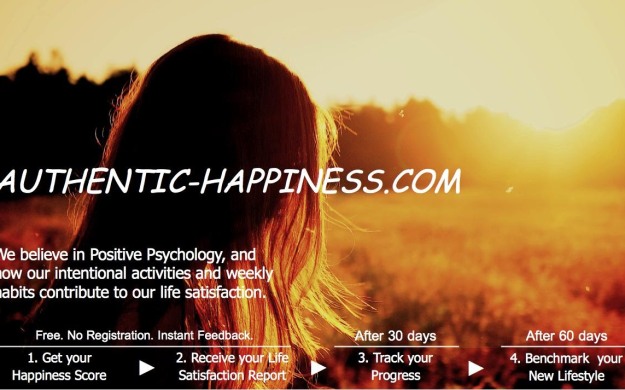
Authentic-Happiness.com, the #1 free global platform to shape your life


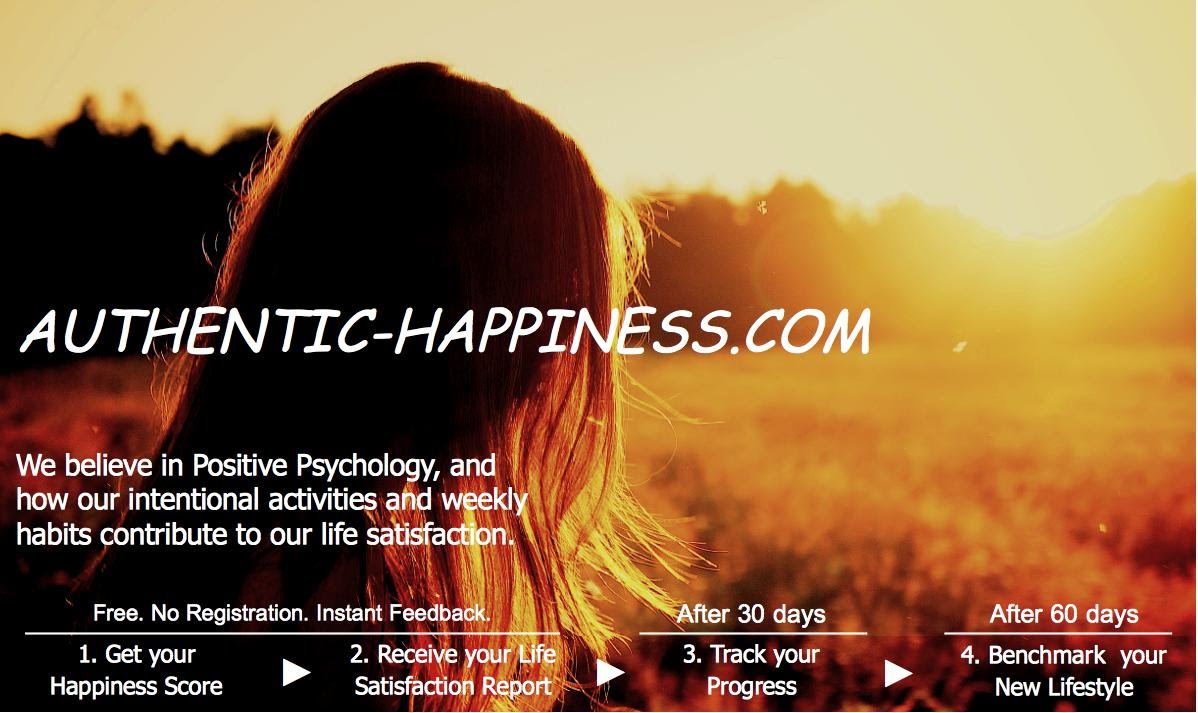
Check your Happiness Score, get your Life Satisfaction report: free, no registration, instant feedback.

Happiness fact 50: Keys to a happier, healthier life (a Hardward study)

Research suggests that certain personal attributes—whether inborn or shaped by positive life circumstances—help some people avoid or healthfully manage diseases such as heart attacks, strokes, diabetes, and depression. These include:

* Emotional vitality: a sense of enthusiasm, hopefulness, engagement

* Optimism: the perspective that good things will happen, and that one’s actions account for the good things that occur in life

* Supportive networks of family and friends

* Being good at “self-regulation” i.e. bouncing back from stressful challenges and knowing that things will eventually look up again; choosing healthy behaviors such as physical activity and eating well; and avoiding risky behaviors such as unsafe sex, drinking alcohol to excess, and regular overeating...

Let's think about these four life happiness boosters as we look ahead into a new year.

Source: Sara Rimer, Madeline Drexler, Harvard School of Public Health, https://www.hsph.harvard.edu/news/magazine/happiness-stress-heart-disease/
 
Authentic-Happiness.com, the #1 free global platform to shape your life
Check your Happiness Score, get your Life Satisfaction report: free, no registration, instant feedback.
healthy_happy_life-e1432316693573.jpeg

Happiness fact 48: emotional well-being rises by 15% on weekends

Happiness spikes on the weekend and drops when the work week begins. Call it ‘weekend bliss’ or the ‘Monday blues,'” said Cristobal Young, an assistant professor in sociology who co-authored the study with Chaeyoon Lim from the University of Wisconsin-Madison.

Emotional well-being rises by about 15% on weekends, the study shows. This reflects both more positive emotions like happiness and enjoyment, and fewer negative emotions like stress, anger and sadness. The findings are based on a study of 500,000 Americans in the Gallup Daily Poll and eight years of data from the American Time Use Survey.

Source: Cristobal Young, and Gallup Study (2014)

Authentic-Happiness.com, the #1 free global platform to shape your life

Check your Happiness Score, get your Life Satisfaction report: free, no registration, instant feedback.

Happiness fact 42: eudaimonia: what is that?

Eudaimonia, sometimes anglicized as eudaemonia, is a Greek word commonly translated as happiness or welfare; however, "human flourishing" has been proposed as a more accurate translation.

Etymologically, it consists of the words "eu" ("good") and "daimōn" ("spirit").
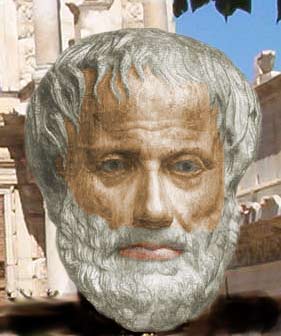
In Aristotle's works (384 BCE), eudaimonia was used as the term for the highest human good, and so it is the aim of practical philosophy, including ethics and political philosophy, to consider what it really is, and how it can be achieved.

It is the spirit of goodness or the good that we seek for its own sake and not for the purpose of achieving any other good.

What about you? Did the "Spirit of the Good" visit you today???

Source: Aristotle (384)

Authentic-Happiness.com, the #1 free global platform to shape your life
Check your Happiness Score, get your Life Satisfaction report: free, no registration, instant feedback.
Aristotelesbunt.jpg

Happiness fact 41: hedonism = what we learn from ancient Greece about happiness

Years ago, a little argument developed among a bunch of free Greek men with too much time on their hands and too many neurons for their own good. They were trying to create a definitive description of the Good Life.
Their argument stretched across several decades, and many luminaries joined in; Gorgias, Aristotle, Aristippus, Epicurus, Epictetus, Plato, etc.
  • Homer represents the hedonic argument, famously defended by Aristippus. Hedonic happiness is getting what feels good and avoiding what feels bad.
  • Meredith represents the eudaimonic argument, famously defended by Heart Boy himself, Aristotle. Eudaimonic happiness is working to develop your virtues to their greatest capacity.
Psychologists are working to resolve the question of whether these are different kinds ofhappiness, different routes of happiness, different sides of the same happiness coin, or two names for the same thing, like puma and cougar. For most people, the best life is one that combines the two. Most of us want to feel good, few of us like pain, and most of us would like to be good people and fulfill our potential in the time we have.

Source: Seeking a life that matters. by Michael F. Steger, Ph.D. (2009)

Authentic-Happiness.com, the #1 free global platform to shape your life
Check your Happiness Score, get your Life Satisfaction report: free, no registration, instant feedback.
Poseidon_sculpture_Copenhagen_2005.jpg

Happiness fact 40: 60% of employees rate their job as "not very meaningful"

 Source: 1,600 respondents, Authentic-Happiness.com survey

Now, this is feedback, to corporations, to leaders, to direct supervisors and to our "beloved" Human Resource department.

With a more volatile, younger generation entering the job market, the challenge of defining meaningful job assignments will be even more acute and critical to building an experienced loyal workforce.

At the same time, only 27% believe that they spend enough time rate doing what they are passionate about:
  • What if we could ignite some new passions and reconnect those with our daily work?
  • What if learning and leadership was so engaging that employees would become over time true passionate experts in their field of work: this sounds like Utopia Inc. !
Authentic-Happiness.com, the #1 free global platform to shape your life

Check your Happiness Score, get your Life Satisfaction report: free, no registration, instant feedback.

Happiness fact 36: 5 pillars of happiness: health emotions skills social meaning (AH, 2015)

The Pillars of Happiness
 Covering all key aspects of our life and 100% and mutually exclusive!

If you go online and check for personal development methods like PERMA from Prof. Seligman's positive psychology, read books and magazines about happiness (Anthony Robbins and others), get in tune with the flavor of the months, happiness secrets and concepts such as mindfulness all revolved around the following five core concepts:

1. LIFE IS FUN, MAKE IT LAST SLEEP WELL, SAVOR HEALTHY MEALS, STAY ACTIVE

2. EMOTIONS ARE BEAUTIFUL, EMBRACE THEM EVERYDAY\ DISCOVER YOURSELF, EXPERIENCE LIFE, BE GRATEFUL.

3. YOUR TALENT IS A GIFT, MAKE USE OF IT, BECOME AN EXPERT UNCOVER WHAT YOU LOVE, HONE YOUR SKILLS, CREATE SOMETHING UNIQUE.

4. LIFE IS AN ADVENTURE, GO OUT, DISCOVER THE WORLD TRAVEL OFTEN, MEET NEW PEOPLE, OPEN YOUR MIND & YOUR HEART.

5. THIS IS YOUR LIFE, LIVE YOUR DREAM NOW SEIZE NEW OPPORTUNITIES, LEAD A MEANINGFUL LIFE, SHARE YOUR PASSION! 

These five pillars form provides a common framework for the natural development of the overall vision, planning and tracking of our activities to shape a more meaningful life and maximize happiness throughout our entire days, weeks, months and years.

This framework has been designed to comply with the following design principles:
· The 100% rule: this means that 100% of the activities, tools and methods to achieve the goal of living a meaningful life are covered in one of the five pillars:
 · Mutually exclusive elements: in addition to the 100% rule, it is important that there is no overlap in scope definition between the different pillars. The goal there is to remove any ambiguity which could result in duplicated activities or misunderstanding.

Source: www.Authentic-Happiness.com (2015)

Authentic-Happiness.com, the #1 free global platform to shape your life

Check your Happiness Score, get your Life Satisfaction report: free, no registration, instant feedback.

Happiness fact 31: 27% spend enough time doing what we are passionate about

Employees who rate their job as "not very meaningful". (1,600 respondents, Authentic-Happiness.com survey).

Now, this is feedback, to corporations, to leaders, to direct supervisors and to our "beloved" Human Resource department. With a more volatile, younger generation entering the job market, the challenge of defining meaningful job assignments will be even more acute and critical to building an experienced loyal workforce.

At the same time, only 27% believe that they spend enough time rate doing what they are passionate about. What if we could ignite some new passions and reconnect those with our daily work? What if learning and leadership was so engaging that employees would become over time true passionate experts in their field of work: this sounds like Utopia Inc. !

Maybe, but there is no doubt that getting closer to this goal would result in significant performance gains. Isn't this the ultimate goal of the learning department?

Source: www.Authentic-Happiness.com (2016)

Authentic-Happiness.com, the #1 free global platform to shape your life

Check your Happiness Score, get your Life Satisfaction report: free, no registration, instant feedback.


Happiness fact 25: subjective wellbeing = daily feelings + life evaluation (Kahneman, 2010)

Recent research has begun to distinguish two aspects of subjective well-being.

Emotional well-being (= short-term) refers to the emotional quality of an individual's everyday experience—the frequency and intensity of experiences of joy, stress, sadness, anger, and affection that make one's life pleasant or unpleasant.

Life evaluation (= longer-term) refers to the thoughts that people have about their life when they think about it. Emotional well-being also rises with log income, but there is no further progress beyond an annual income of ~$75,000.

Source: Daniel Kahneman and Angus Deaton , Proceedings of the National Academy of Sciences of the United States of America (2013)

Authentic-Happiness.com, the #1 free global platform to shape your life

Check your Happiness Score, get your Life Satisfaction report: free, no registration, instant feedback.

Happiness fact 23: 40% have not discovered a satisfying life purpose

About 4 out of 10 Americans have not discovered a satisfying life purpose. Forty percent either do not think their lives have a clear sense of purpose or are neutral about whether their lives have purpose

Source: US Center for Disease Control (2013)

Authentic-Happiness.com, the #1 free global platform to shape your life

Check your Happiness Score, get your Life Satisfaction report: free, no registration, instant feedback.


Happiness fact 17: 0.79: the correlation between Meaning and Happiness

Meaning and Happiness

J. Coyne started by examining the correlation between these two subscales and it was r = 0.79, ( p < 0.0001). The high r is the higher the correlation.

This correlation is as high as the reliability of these two sub-scales allows, meaning they are essentially interchangeable and measure the same thing.

In simple words, add meaning to your life, define meaning in your terms, whether it is a charitable contribution, raising your children, inventing a new app or expressing yourself in blogs or paintings...
The more meaning, the more happiness in your life.

Source: James Coyne PhD, 2013

Authentic-Happiness.com, the #1 free global platform to shape your life
Check your Happiness Score, get your Life Satisfaction report: free, no registration, instant feedback.